
Coding Hero Academy
Tech-learning game for school students
integrated into the Codingjr learning app primarily used by students of partner schools, soon to be marketed as a b2c app after increased refinement and retention.

Role
Product Designer
& Strategist
Duration
1 month
Team
Engineering Team
I owned
Research, Product Strategy, Flows, UI Design, Gamification
Platform
Mobile App
(B2B2C → B2C)
Constraints
Tight deadline, Devs on notice period
Executive Summary
CodingJr's partner schools had their study material, virtual labs and tests on the app, but still no student engagement. I designed a gamified learning ecosystem spanning four tech domains. I led game mechanics and visual identity to companion characters and a phygital reward loop in one month. After a 40-student beta and two critical iterations, the game went live across partner schools. 74% of students returned on Day 30 without a single teacher prompt. 600+ schools adopted it as a core student engagement offering.
Problem
What was broken?
Partner school students had no incentive to open our learning app outside class while we planned to launch it as a B2C app. We had to appeal to students and fit into their free-time, learning goals and existing interests.
Results
What changed?
Students got a structured, self-driven learning path they actually returned to. 74% Day-30 retention. 600+ schools adopted the game as a central offering.
What were some key problems?
Student Front (B2B2C):
Our tech-learning module integration offered no incentive to self-study
Students expected gamification from the dedicated learning app and cited other apps as examples,
Students spent a lot of time on phone otherwise at home, playing games and watching Youtube.
University Front (B2B) :
Schools paid per student and low engagement undermined the value proposition
CodingJr needed a B2C expansion angle; a game was the strongest candidate
Codingjr schools did not have much to differentiate themselves from schools that teach coding and have their own apps.
Why Solve This?
Business Value
Schools paid per student. A game driving daily logins made the subscription feel worth it and gave the sales team a stronger pitch for new schools.
User Value
Adolescent students are the biggest demographic of mobile gamers. Tech knowledge in 10-minute game sessions is accessible to students who'd never sit through a lecture.
Strategic Fit
By integrating the game experience into the physical school experience, we built an unbreakable bond between codingjr subscription and the school culture.
Exploration & Insights
What to keep:
Active recall through MCQs, snippet arrangement, and True/False.
Leaderboards, streaks, badges, milestones and rewards for habit formation and healthy competition
Companion characters giving the experience emotional texture and personalisation
Multi-format learning reducing cognitive fatigue across a session
What to change:
Prioritise content quality over over-gamification
Too many gamified elements and rewards disrupt learning journey
Question/answers without context are just one-time wins
No revision leads to no retention -- the game has to be reward revision
If making a feature leads us to charging a premium fee, shouldn’t make it
Lifeline system is always better for experience and autonomy
Explored the gold standard of Gamification --Duolingo (and other coding games such as mimo) articles, reviews and discussions
Team Alignment & Collaboration
Workshops
Ran game mechanic walkthroughs to align on feasibility before designing flows. All the game logic logic, analytics and capabilities were designed along with team discussions to avoid architectural dead-ends.
Trade-offs
-Gave up Usability Testing to ship before school pitch season.
- Skipped multiple micro-interactions and animations in development due to limited dev. team capabilities.
Managing Stakeholders
-Gave detailed scenarios and walkthroughs to the CTO and co-founder thrice a week to maintain their interest and excitement.
Visual Design Direction
Ran a visual validation study with 179 students across two schools. 68% chose the high-energy, vibrant UI and the 32% chose the minimal UI. Students playing a game after school want it to feel like a game, not a study portal. So I decided to strike a balance.

Key Design Decisions
The 5 lifeline model locks the lesson on loss but students can spend coins to reduce lockout, or unlock by revising the previous chapter with a perfect score. Lockout is the revision loop mechanism.
You’ve made a fantastic choice!
We are getting your chapter ready.
You need to revise this level, and reattempt all
questions with a 100% score without losing
any lifeline to unlock your locked chapter.
Lockout time reduced!
Your lockout time has been reduced. Lesson 3 will unlock in
Revise a Level
30:00
Revise previous chapters to use this time
effectively.


You’ve lost all your lifelines.

To ensure deep learning, Lesson 3 is now locked for 2:00:00.
Unlock the chapter
right now for
30 coins
Unlock by revising with a perfect score
Level 14
Exit game
You’ve lost all your lifelines.

To ensure deep learning, Lesson 3 is now locked for 2:00:00.
Reduce lockout time to 30 mins for
20 coins
Unlock the chapter
right now for
30 coins
Exit game
Use your coins to reduce/remove lockout
or unlock revision as currency after a certain level
9:41
Game Design

Continue

Lesson Unlocked
You can continue learning lesson x at Level x, with increased focus now.

9:41
Lesson Unlocked!

Continue Learning
Coins spent:
-20
Pay attention to the question type to give
more accurate answers.
A 60-minute timer to ensure equitable competition between phone owners and borrowers.
9:41
28
Let's remember how to code a main heading on a webpage. Code an HTML element that displays the text "Welcome!" as the largest heading.
Tap the snippets below and arrange in correct order
file name.html
Continue

Compiler
Output
Welcome
You’ve finished your daily
60 minutes!
After finishing this chapter, we encourage you to take a break today.
Finish this chapter and then relax
Play later
Extend game time by 30 minutes
20 coins
Exit game

A reward wheel after every 3 chapters (1 sitting average) to keep the delight high
9:41




+20
+20
New
chapter

Boss Quiz
+10
2x xp
multiplier


Better luck
next time!

GO
+25
+5
+10
+10
+5
Wheel of Fortune
Spin & Win exciting Rewards!

Revision boss quiz positioned as the ultimate reward as it gives the opportunity to win the most xp and coins
9:41
Boss Quiz 2 Completed
Overall Score
90%
Xp
120
20
Continue
Wow you did it!
View Level-wise performance

Bite-sized content on an
easy-on-the-eye blue background, no juicy UI
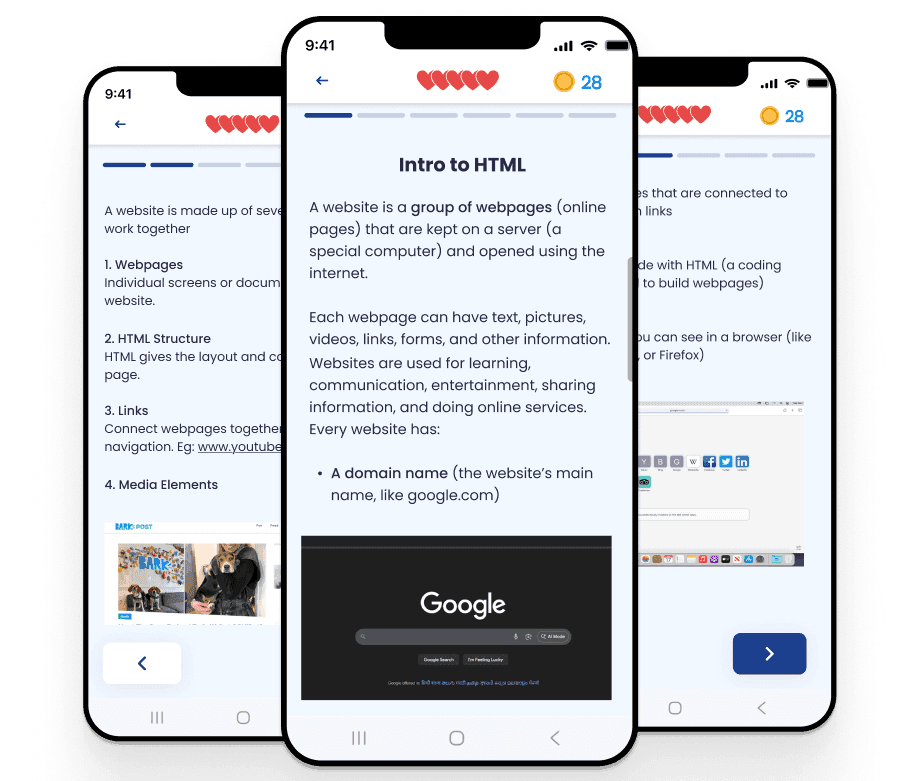
Simple active-recall based coding problems,
True/False, Snippet Arrangement


Juicy UI limited to celebratory screens
Phygital (Physical + Digital Game loop)
Integrating the gamified learning experience into physical school environment gets a student academic validation and social recognition while cementing a strong loop between the home-learning and school-learning journey. Adopted in pilot by 32 schools with plans to expand to more.
In online game
in offline school
Winning titles and acing the leaderboard . . .
. . . leads to students being celebrated in weekly assembly and appearing on “hall of fame” bulletin with their equipped titles
Extraordinary performance, perfect game completion, and acing all games . . .
. . . gets students discount coupons and free resources from the company repository
Four distinct companion archetypes . . .
. . . appears as standees and cutouts in summits, events and competitions for better brand positioning, brand recall and character attachment.
Pilot Feedback & Insight
Apollo School, Ahmedabad — 40 students (20 Grade 5, 20 Grade 10). 45 minutes in class, then 3 levels independently over 5 days.
Failures
Focus music played without explanation. Students in class didn't hear it; at home they couldn't identify the source.
60-minute hard stop felt punitive, especially to students performing well. "Getting locked out for doing well" was common feedback.
Lockout caused drop-off. Students redirected to other app sections and didn't return to the game before the next school day.
Actions Taken
Added an onboarding screen establishing the purpose of focus music with clear instructions to mute it.
Reframed the timer in onboarding. Students can now finish the current chapter after the timer runs out. Added a floating removable timer visible throughout the app.
Added a persistent floating timer throughout the app. Lockout screen now suggests revising previous levels — turning the wait into a revision prompt.
Business & User Impact (30 days)
67%
students returned after 30 days with no teacher prompting
600+
schools adopted the app as a key offering; 32 are running phygital pilot
5%
mark up in the subscription fee and 98% schools stayed
What’s next
AI-supported adaptive difficulty and companion-delivered hints that couldn't ship in v1.
Parental engagement layer: progress nudges, badge sharing, time-spent data
Online multiplayer: real-time coding battles and quiz combat for extended daily engagement
Companion accessories purchasable with coins — expanding the coin economy loop
B2C launch: with retention data and refined mechanics, this is CodingJr's strongest standalone B2C candidate.